RICSRegulated firm
0161 850 4672
House Smart Surveying
Get a quote
Survey types

Which survey do I need? A decision guide by property age, type and condition

There are really only four questions worth asking before you book: how old is the property, has it been altered, what shape is it in, and is it new? Answer those honestly and the right survey usually falls out on its own. This guide works through each in turn.

18 Feb 202610 min read
Which survey do I need? A decision guide by property age, type and condition

Start with the age of the property

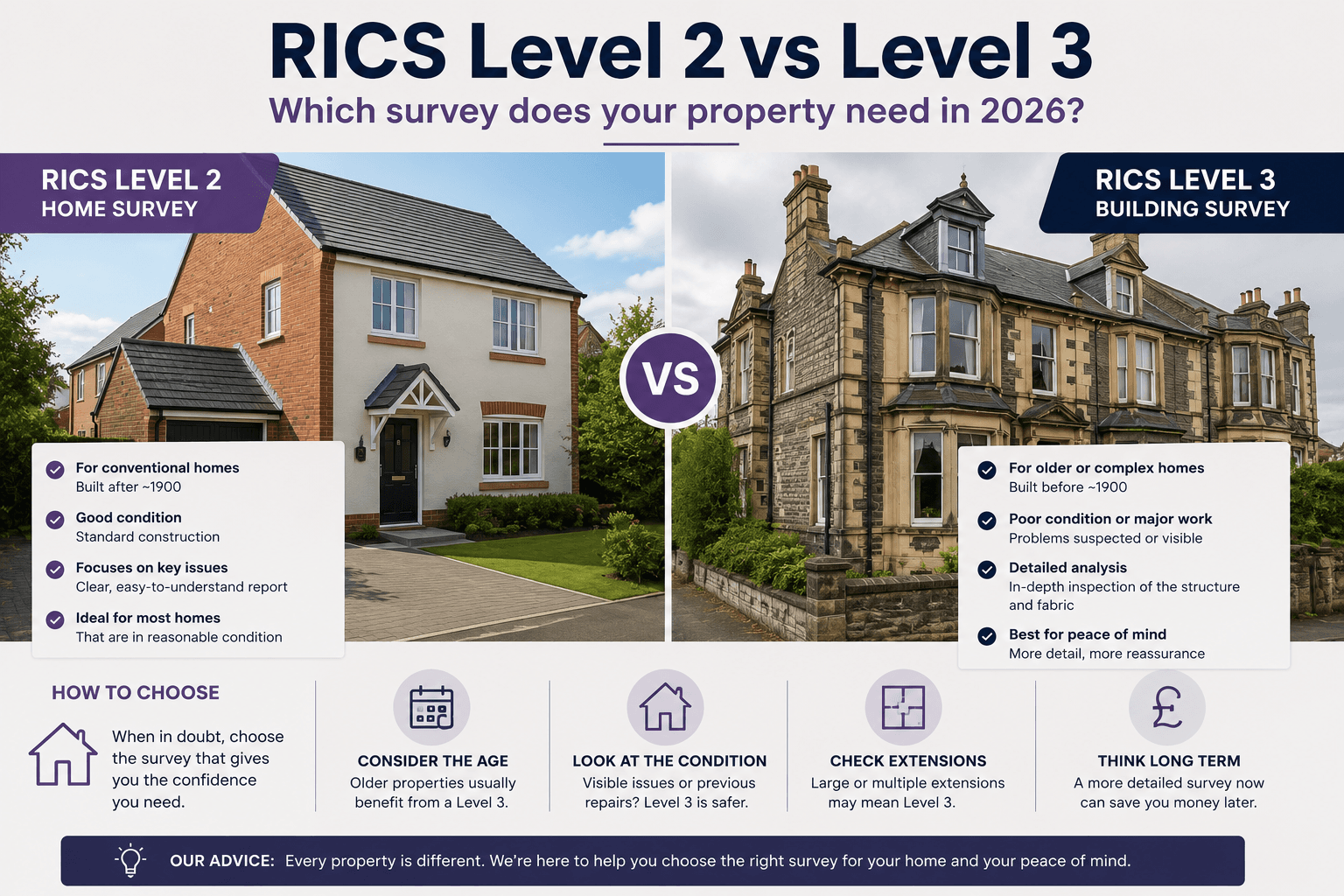
Age is the single strongest predictor of which survey you need, because it correlates with construction method, materials and the likelihood of undocumented alterations. As a working rule: 1900 onwards, standard construction, points to a Level 2. Before 1900, or anything of non-standard or solid-wall construction regardless of age, points to a Level 3.

The 1900s-1950s band is where most genuine judgement calls happen — a well-maintained, unaltered inter-war semi of standard brick-and-block cavity construction is often a perfectly good Level 2 candidate, while an equivalent property with a loft conversion and a rendered elevation usually is not.

1900
The rough construction-era line between Level 2 and Level 3 territory
3 questions
Age, alteration history and visible condition decide most cases
Free
Cost of a written recommendation from a RICS Regulated surveyor before you book

By property type

Modern flat or new-build house. A Level 2 is usually the right fit, whether it's a resale flat in good order or a newly built home in reasonable condition.
Victorian or Edwardian terrace. A Level 3, close to without exception — solid-wall construction and a long history of alterations make the cause-analysis essential.
1930s-1970s semi or detached, standard construction. A Level 2 if unaltered and in reasonable order; a Level 3 if extended, rendered, or showing visible cracking.
Listed building or conservation area property. A Level 3, and factor in that unusual materials may need specialist follow-up beyond the survey itself.
Ex-local authority or non-traditional construction (steel-frame, PRC, timber-frame). A Level 3, and check mortgageability with your broker before you commit to the purchase.

Then weigh what you can already see

Age gives you a starting point; condition can override it. A modern, unaltered home with visible cracking around window and door openings, a sagging roofline, or persistent damp staining on a viewing is a Level 3 candidate regardless of its age, because those signs suggest something beyond routine maintenance is going on and you want the cause explained, not just the symptom rated.

Conversely, an older property that has been comprehensively renovated with proper building control sign-off, has no visible defects, and where you can see clear evidence of the work (certificates, warranties, planning approvals) can sometimes be a reasonable Level 2 candidate — though we would still want to see that paperwork before confirming it.

Book a Level 3 when you see…
Visible cracking around openings, or a roofline that isn't straight
Render or pointing that looks recently redone, with no paperwork to explain why
A loft, garage or basement conversion of unknown vintage
Persistent damp staining, musty smells, or peeling internal decoration
Any construction method you don't recognise as standard brick-and-block
A Level 2 is proportionate when…
The property is post-1900, standard construction, and unaltered
There's no visible cracking, damp staining or structural concern
You have building control paperwork for any past works
You're not planning significant renovation of your own
The property is a straightforward flat, terrace, semi or detached house
We would rather talk a buyer out of an unnecessary Level 3 than let them under-survey a property that needs one. Neither outcome makes us any friends with a sales target, which is exactly why we don't have one.

Weighing budget against risk

The fee difference between a Level 2 and a Level 3 is real but modest set against the purchase price — typically a few hundred pounds on a home costing hundreds of thousands. The cases where buyers regret under-specifying are almost always the ones where a Level 2's condition rating flagged something without explaining it, and the buyer only discovered the true cause (and cost) after completion, with no further recourse.

If you are genuinely torn between the two, the deciding question we'd ask is: could I afford to be wrong about the cause of a defect on this specific property? If the answer is no, book the Level 3.

Not sure which survey your property needs?

Send us the postcode and a few details and we'll recommend the right level, in writing, before you book.

Get my quote

Choosing a survey: FAQs

Not sure which survey fits your property?
Six short questions, a personal recommendation, no obligation.
Help me choose

Ready to book your survey?

Fixed fees, no obligation, and your report back within 3 to 7 working days depending on report type. Start with your postcode or talk to a surveyor first.