 Regulated firm
Property dampness: a chartered surveyor’s guide
Damp is the most common defect our surveyors encounter, and one of the most misdiagnosed defects in UK housing. Rising damp, penetrating damp and condensation each have different causes, different remedies, and wildly different costs. Treating the wrong one wastes money and leaves the problem in place.
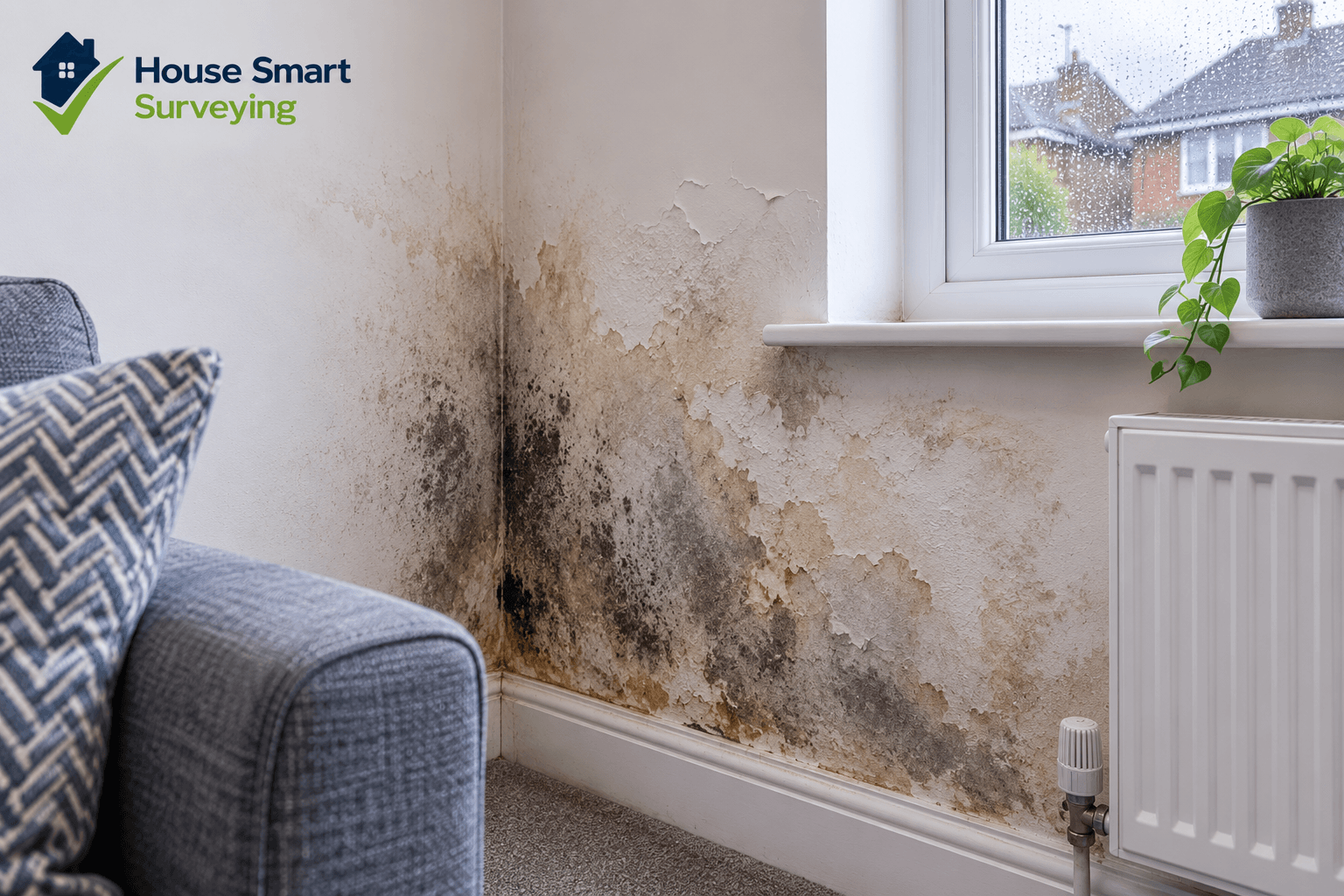
Tell-tale signs a buyer will notice include tide marks on internal walls, peeling decoration, musty smells, black mould in corners and window reveals, and white salt deposits (efflorescence) on plaster. But the visible symptom is rarely the whole story: the cause may be a bridged damp-proof course, defective rainwater goods, blown external render, or simple lack of internal ventilation.
Our surveyors take calibrated moisture readings, trace the moisture path to its source, assess the ventilation regime, and give you a clear written diagnosis with the appropriate remedy. We do not sell damp treatments, so there is no product for us to push.
For most residential buyers, a Level 2 HomeBuyer Report is sufficient for damp identification. For older solid-wall properties, complex damp patterns, or where the cause is not obvious, we would recommend a Level 3 Building Survey because the cause-analysis is where a Level 3 earns its cost.
Be wary of free damp surveys from treatment companies. The diagnosis tends to match whatever they sell. An independent RICS surveyor has no product to push and no commission to earn.
What we look for on site
The three types of damp, and how they differ
Rising damp comes up through the wall from the ground because the damp-proof course is failing, bridged, or absent. It presents as a tide-mark no higher than around 1.2m, often with salt bloom. It is rare — well under 10% of the “damp” cases we see are truly rising damp.
Penetrating damp comes in laterally through the fabric from a specific defect: a leaking gutter, blown render, failed pointing, defective flashing. It presents as localised patches, often high on the wall or around openings, and it worsens in prolonged rain. Roughly 60% of damp cases.
Condensation damp forms internally where warm humid air meets a cold surface. It presents as black mould in cold corners, along window reveals and behind furniture. Roughly 30% of cases, and rising with modern build tightness.
What a proportionate remedy looks like
A responsible damp diagnosis names four things: the mechanism, the source, the extent, and the remedy. Missing any of the four is missing the point. If a report simply says “damp present, chemical DPC recommended”, get a second opinion before authorising the work — the same symptoms with different causes need different fixes.
“The single most expensive damp treatment is the one aimed at the wrong mechanism. It doesn’t work, and you still have to pay for the right one afterwards.”